> For the complete documentation index, see [llms.txt](https://charity.childsafetyfund.org/llms.txt). Markdown versions of documentation pages are available by appending `.md` to page URLs; this page is available as [Markdown](https://charity.childsafetyfund.org/strategy/education/readiness.md).

# Readiness

The *2023 Community Assessment for the Oklahoma State Plan for the Prevention of Child Abuse* provides a detailed snapshot of professional readiness and systemic barriers to recognizing and reporting child abuse and neglect across the state.&#x20;

Developed by the Oklahoma State Department of Health’s Family Support and Prevention Services (FSPS) in collaboration with OCCY, OKDHS, and OPSR, the survey (n = 707 professionals; n = 307 parents) captures perspectives from educators, healthcare providers, social workers, and administrators statewide.

{% file src="/files/n4HWbeKiIyRmNR8g6AwD" %}

These findings directly support CSF’s strategy to establish standardized, accessible mandated-reporter training as a statewide prevention measure.

### Key Findings

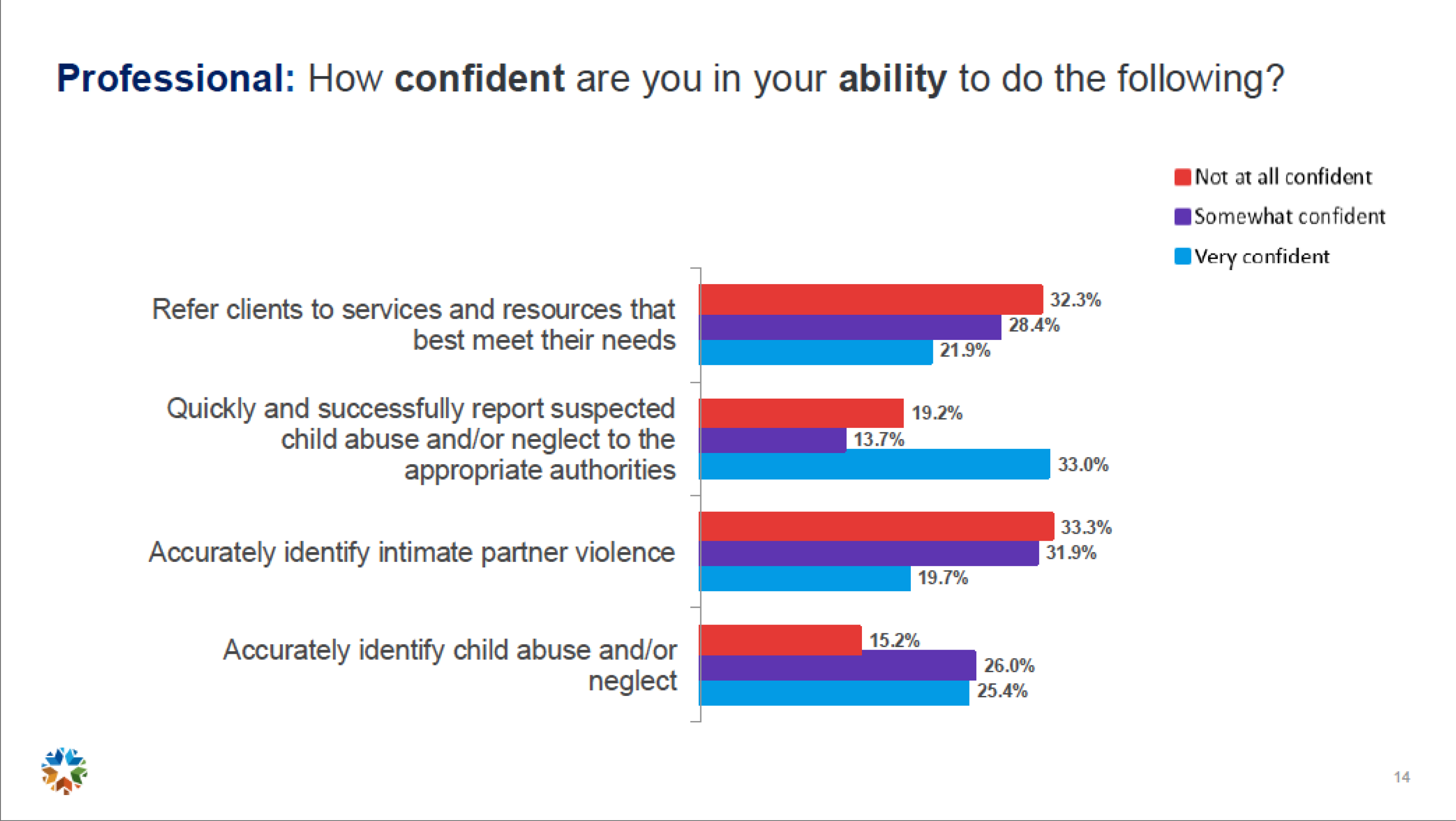
<figure><img src="/files/uUPqjF8mWTdLL1iaMome" alt=""><figcaption><p>Figure 1. Professional confidence levels in identifying and reporting child abuse and neglect. Source: Oklahoma State Department of Health (2023), Community Assessment Results – Oklahoma State Plan for the Prevention of Child Abuse.</p></figcaption></figure>

{% hint style="info" %}

### **Data at a Glance (page 14)**

* Only 13.7 % of professionals felt *very confident* in their ability to report suspected child abuse or neglect.
* Only 25.4 % felt *very confident* identifying child abuse and neglect.
* \~40 % expressed low or no confidence in both areas.
* 60 % of professionals had not received *any formal training* on recognizing or reporting abuse in the past two years.
  {% endhint %}

{% hint style="info" %}

### **Survey Respondent Roles**

* Education and Teaching: 33.5 %
* Healthcare and Nursing: 18.5 %
* Social Work and Counseling: 11 %
* Administration and Management: 7 %
* Volunteer and Advocacy: 4.5 %
* Research and Data: 4.5 %
* Other Professions: 21.5 %
  {% endhint %}

**Training and Awareness Gaps**

* Nearly 60 % of professionals reported *no recent training* in identifying or reporting abuse or neglect.
* Among those trained, more than half rated the instruction as *minimally helpful* or *outdated*.
* Professionals emphasized that training requirements vary widely by agency, leading to inconsistent knowledge across disciplines.
* The report explicitly concludes that *“Oklahoma lacks a unified, evidence-based training standard for professionals required to report child maltreatment.”*

***

**Workforce Capacity and Confidence**

* Only 13.7 % of respondents felt *very confident* about reporting suspected abuse, and 25.4 % about identifying it.
* More than 40 % expressed little or no confidence in these critical skills.
* Qualitative feedback revealed that fear of making incorrect reports and uncertainty about legal protections deterred professionals from reporting—especially educators and healthcare workers.
* The assessment warns that this lack of confidence *“creates hesitation and delay at critical moments when children’s safety is at stake.”*

***

**Rural and Access Disparities**

* Professionals from rural and frontier counties identified *major barriers* to accessing training—70 % reported limited or no local options.
* Respondents recommended online and multimedia learning platforms as equitable solutions for reaching dispersed professionals.
* The report calls for “expanded digital and multimedia training platforms to ensure equitable access for all mandated reporters.”

***

**Cross-Sector Collaboration Needs**

* Participants described fragmented communication between education, healthcare, and child welfare systems.
* Stakeholders urged development of “a unified, cross-disciplinary training model” to align definitions, expectations, and reporting procedures statewide.
* Consistent statewide training was identified as the *key mechanism* to strengthen collaboration and data sharing.

***

#### Implications for CSF’s Strategy

The *2023 Community Assessment* clearly demonstrates that inconsistent training, low professional confidence, and rural inequities are among the greatest barriers to effective mandated reporting in Oklahoma.

CSF’s proposed standardized multimedia training directly addresses these deficiencies by:

* Establishing a statewide learning framework aligned with best practices;
* Delivering scenario-based, video-driven modules that strengthen recognition and reporting confidence;
* Providing on-demand digital access to close the rural training gap;
* Reinforcing cross-sector coordination through unified terminology and protocols.

***

### Sources

1. [<sup>https://oklahoma.gov/content/dam/ok/en/health/health2/aem-documents/family-health/fsps/child-abuse-prevention/2023%20Community%20Assessment%20Results-Oklahoma%20State%20Plan%20for%20the%20Prevention%20of%20Child%20Abuse.pdf</sup>](https://oklahoma.gov/content/dam/ok/en/health/health2/aem-documents/family-health/fsps/child-abuse-prevention/2023%20Community%20Assessment%20Results-Oklahoma%20State%20Plan%20for%20the%20Prevention%20of%20Child%20Abuse.pdf)


---

# Agent Instructions
This documentation is published with GitBook. GitBook is the documentation platform designed so that both humans and AI agents can read, navigate, and reason over technical content effectively. Learn more at gitbook.com.

## Querying This Documentation
If you need additional information that is not directly available in this page, you can query the documentation dynamically by asking a question.

Perform an HTTP GET request on the current page URL with the `ask` query parameter, and the optional `goal` query parameter:

```
GET https://charity.childsafetyfund.org/strategy/education/readiness.md?ask=<question>&goal=<endgoal>
```

`ask` is the immediate question: it should be specific, self-contained, and written in natural language.
`goal` is optional and describes the broader end goal you are ultimately trying to accomplish on behalf of the user. GitBook uses it to tailor the answer towards what is most useful for that goal.

The response will contain a direct answer to the question and relevant excerpts and sources from the documentation.

Use this mechanism when the answer is not explicitly present in the current page, you need clarification or additional context, or you want to retrieve related documentation sections.
